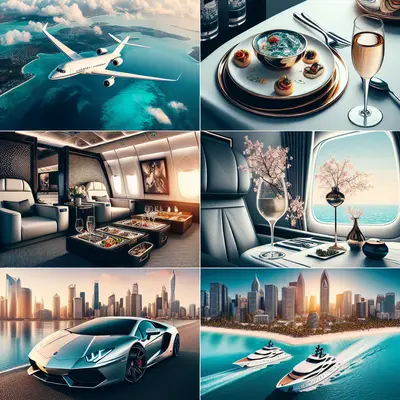
The most interesting journeys today are not defined by cabin class or postcard views, but by how discreetly they rewrite the traveler’s relationship with time, privacy, and access. The true hallmark of contemporary luxury travel is not excess; it is orchestration—of silence, of service, of space. For those who move easily between continents and commitments, travel has become less of an escape and more of a finely tuned operating system for a life lived at altitude.
Below are five exclusive, quietly powerful insights shaping how discerning travelers design their movements now.
1. Time as the Ultimate Suite Upgrade
The most coveted amenity in luxury travel is no longer a landmark view—it is reclaimed time. High-net-worth travelers are increasingly treating hours as a currency to be defended with the same precision as capital allocation.
This is driving an appetite for “frictionless corridors”: pre-cleared border control, private airport transfers that bypass public terminals entirely, and tightly choreographed ground handling where bags appear not at a carousel, but already unzipped in a dressing room. Private aviation and top-tier commercial cabins are now being evaluated less on seat width and more on the “time delta” they offer: door-to-door minutes saved, cognitive load reduced, decisions pre-removed.
On the ground, luxury hotels that understand this shift are quietly redesigning experiences around temporal efficiency. Mobile check-in that actually works, 24/7 housekeeping on demand instead of rigid service windows, and concierge teams that deliver options in “decision-light” formats—three curated, verified choices instead of fifteen brochure-ready suggestions. The refined traveler is not looking to be dazzled at every turn; they are looking for time to arrive unhurried, fully present, and strategically under-scheduled.
2. Privacy Beyond the Suite: Architecting Invisible Boundaries
Privacy has long been a luxury promise, but its contours are changing. What affluent travelers are seeking now is not isolation, but controlled exposure: the ability to step fluidly between visibility and anonymity without renegotiating boundaries at every turn.
This is expressed in the preference for “layered privacy” over blunt seclusion. Instead of remote compounds or heavily guarded villas that feel defensive, travelers are gravitating toward properties and services that subtly segment space—private floors within city hotels, semi-cloistered lounges within major hubs, and villas with separate service corridors that keep operations elegantly offstage. The aim is to be surrounded, but not surveilled; attended, but not observed.
Data privacy has become equally critical. The truly premium operator knows that discretion extends to the digital dimension: encrypted communications with concierge teams, minimal data retention on guest preferences, and transparent policies around biometrics used for expedited security and check-in. For high-profile clients, the difference between “luxury” and “off-limits” can hinge on whether a property’s promise of privacy is supported by strong, modern information governance and staff trained to treat guest presence as confidential by default.
3. Hyper-Contextual Experiences Over “Bucket List” Tourism
The era of the checklist trip—three cities, six attractions, twelve photographs—is quietly fading at the top end of the market. Luxury travelers with global fluency are no longer seeking to see the world; they are looking to understand specific, nuanced fragments of it with rarefied clarity.
Instead of “best of” tours, they are commissioning experiences that are hyper-contextual: exploring a city through its independent bookshops and private collections; understanding a coastal region through time spent aboard working vessels, marine research outposts, and low-profile dining rooms that don’t accept reservations from just anyone. The value lies in a narrative arc designed around a personal obsession—architecture, contemporary dance, bio-innovations, regional textiles—rather than a generic sense of place.
This shift has recalibrated the role of the luxury travel advisor. The most sought-after are no longer mere access brokers; they are curators of intellectual texture, pairing clients with academics, local creatives, or niche practitioners who can interpret a destination with authority. For the seasoned traveler who has “seen it all,” the rarest pleasure is no longer the iconic view, but the sensation of mental expansion—a new lens, a refocused curiosity—created by being in the right room with the right mind, in a place most visitors barely skim.
4. Silent Sustainability: Quietly Responsible, Impeccably Executed
Among the truly affluent, sustainable travel has moved out of the realm of virtue signaling and into the domain of baseline expectation—yet the most sophisticated travelers are wary of overt “green theater.” They are looking for high-caliber operations where responsibility is deeply embedded, not ostentatiously advertised.
This manifests in what might be called “silent sustainability”: high-performance insulation instead of performative tented camps, renewable energy infrastructure integrated so seamlessly that it never becomes a talking point, and local supply chains that support regional economies without turning every interaction into a staged encounter. The finest properties and operators are those whose ecological and social commitments can be felt in the quality of the air, the integrity of the cuisine, and the longevity of the staff, rather than read off a plaque.
For discerning guests, due diligence now extends beyond aesthetics into governance. They want to know who owns the land, how seasonal staff are housed, whether marine or wilderness permits are being managed with long-term carrying capacity in mind. The truly premium experience is not the illusion of untouched nature, but the confidence that one’s presence is part of a carefully calibrated system designed to endure—one that favors restoration over extraction.
5. The New Craft of Movement: Precision in the In-Between
Luxury used to be defined by where one stayed. Increasingly, it is defined by how one moves. The in-between spaces—airport corridors, transfers, regional hops—were once considered tolerable interludes. Today, they are being reengineered as designed experiences in their own right.
For the global elite, the journey is now a choreography of micro-environments: a car whose cabin lighting and temperature are preset to the traveler’s circadian rhythms after a long-haul flight; a transfer boat that doubles as a tasting room for local producers; a helicopter route chosen not for speed alone, but for a pilot who can read the landscape like a story. Every link in the chain is an opportunity to either drain or refine the traveler’s energy.
The new craft of movement is defined by precision. Luggage is tracked in real time and unpacked before arrival. Health and performance data—sleep cycles, hydration levels—inform which amenities are waiting in the suite. Lounge experiences are recast as functional sanctuaries: spaces with true acoustic insulation, natural light, and ergonomically intelligent seating, rather than branded showrooms. For those whose lives unfold across time zones, a journey that feels physiologically coherent from departure to return is no longer aspirational; it is a standard quietly demanded and meticulously paid for.
Conclusion
Luxury travel has entered a more nuanced, less visible era. The loud signals of status—conspicuous logos, crowded “must-see” itineraries, ostentatious suites—are giving way to a subtler grammar: time reclaimed rather than wasted, privacy structured rather than improvised, curiosity fed rather than entertained, responsibility assumed rather than advertised, and movement crafted rather than endured.
For those operating at this level, the true indulgence is not more; it is better—fewer, more resonant trips; leaner, more intelligent itineraries; and experiences that feel precisely calibrated to a life that values elegance in both motion and stillness. The new luxury is not simply about where you can go, but how quietly, intelligently, and beautifully you can get there.
Sources
- World Travel & Tourism Council – High Net Worth Travelers Report – Analysis of evolving preferences and behaviors among affluent travelers
- Skift – The Rise of the Conscious Traveler – Industry insight into sustainability and responsibility trends in luxury travel
- Virtuoso – Luxe Report – Annual overview of luxury travel trends from a leading network of premium advisors
- McKinsey & Company – The Future of Luxury: Bouncing Back – Strategic perspective on how time, privacy, and experience are reshaping luxury expectations
- International Air Transport Association (IATA) – Travel Pass and Digital Identity – Background on biometric and digital identity initiatives impacting seamless and private travel experiences
Key Takeaway
The most important thing to remember from this article is that this information can change how you think about Luxury Travel.