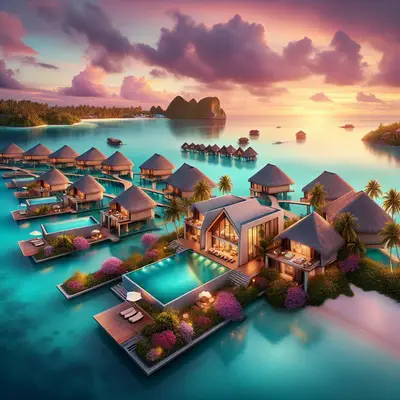
The most coveted resorts in the world no longer court attention; they curate discernment. They exist in a quiet echelon above five-star, where the experience is less about opulence on display and more about an ecosystem of details that anticipate you before you arrive. For the traveler who has already seen the “best” and is now searching for the rare, the private, and the exquisitely considered, exclusive resorts operate by a different set of rules—subtle, rigorous, and deeply personal.
Below are five exclusive insights that help decode how these properties truly work, and how to navigate them with the fluency of an insider.
1. The Most Exclusive Perks Are Never Listed
At the world’s most discreet resorts, the most valuable benefits are rarely found on a website or in a brochure. They live in a quiet, unpublicized tier—extended late checkouts without asking, bespoke amenities aligned to your health routines, private access to museum wings before opening hours, or a last-minute yacht transfer when the helicopter window has closed.
These “off-menu” privileges are the result of meticulously maintained guest profiles and long-standing relationships with external partners. Staff track preferences beyond the expected: not just room category and pillow type, but your preferred pace of service at breakfast, your tolerance for conversation, your favored floral scents, even whether you like a room with afternoon light or morning shadow. The goal is not spectacle, but frictionless continuity—so that your third stay feels as intuitively attuned as your thirtieth.
For the discerning traveler, the insight is clear: loyalty and discretion are the new currencies. Returning to the same property or collection (and cultivating a direct relationship with a senior guest relations manager) often unlocks a layer of privileges that no booking engine can surface and no loyalty app can capture.
2. Privacy Is Engineered, Not Just Promised
True privacy at elite resorts is not a matter of seclusion alone; it is an architectural, operational, and technological choreography. Villas are angled so that sightlines never quite intersect. Pathways are gently curved so that encounters feel coincidental, not crowded. Service entrances and underground corridors ensure that housekeeping appears to “never happen,” yet rooms remain in a perpetually perfect state.
Beyond design, privacy is woven into protocol. Staff are trained as much in what not to notice as in what to anticipate. Photographs are never taken without explicit consent. Discretion clauses appear in staff contracts. Some properties even maintain separate, secure data servers for high-profile guests, with strict access logs and purge schedules to prevent long-term storage of sensitive information.
For luxury travelers, the nuance lies in understanding that the most exclusive privacy is invisible. It is felt in the ease with which you move through the property without interruptions, in the way your presence is acknowledged once and not over-referenced, and in the confidence that your stay will not reappear as social media content—or cocktail-party anecdotes—once you’ve left.
3. True Customization Begins Long Before Arrival
In the upper tier of exclusive resorts, the experience is often shaped more by what happens before you land than what is offered after check-in. Detailed pre-arrival questionnaires, quiet calls with your assistant or travel advisor, and subtle digital touchpoints allow the property to construct a stay that feels almost eerily prescient.
Your villa may already hold your preferred brand of incense, a rotation of still and sparkling waters you drink at home, and a curated selection of in-room reading that reflects both your profession and your current interests. The minibar might be reimagined entirely: replaced with a nutritionally calibrated selection aligned with your wellness goals or adjusted for a post-flight recovery ritual your trainer has shared in advance.
The most refined experiences are not about lavish surprises, but about a sense of continuity with the life you live at your highest standard. Elite resorts now increasingly collaborate with your existing ecosystem—private chefs, doctors, personal trainers, stylists—to ensure that your time away feels like a heightened extension of your life, not a disruption of it.
4. Wellness Has Quietly Become the Central Architecture
Wellness at exclusive resorts has evolved from a spa appointment into a framework that touches nearly every facet of the stay. Menus are designed with circadian rhythms and blood-sugar balance in mind; lighting is calibrated to support sleep quality and recovery from jet lag; soundscapes are tuned to dampen intrusive noise and enhance a state of calm rather than simply to mask it.
World-class properties now partner with medical-grade wellness providers, sleep scientists, and performance coaches to build programs that can be as comprehensive or as invisible as you wish. Guests can receive VO2 max testing, personalized mobility programs, and DNA-based nutrition guidance alongside more traditional therapies—yet all of it can be woven discreetly into a schedule that still feels like a holiday rather than a clinical retreat.
For the sophisticated traveler, the luxury lies in selectivity. The finest resorts offer a spectrum: from deeply immersive programs for those who want measurable outcomes, to subtly supportive environments for those who simply want to feel better without thinking too much about it. The mark of true excellence is the ability to deliver both, effortlessly.
5. Access Is the New Luxury—But It’s Curated, Not Crowded
At the pinnacle of resort culture, what you can access matters more than what you can purchase. Not access in the sense of VIP lines or priority bookings, but of doors that are opened privately, at the right time, and for the right reasons.
This might mean sunrise access to a UNESCO World Heritage site without other visitors in view; a private performance by a conservatory-trained quartet in a remote courtyard; or a chef’s table experience that is not advertised, limited to a single seating for the entire property, and adjusted in real time to your party’s energy, preferences, and conversational tempo.
The distinction is subtle yet critical: access is not about being first in line; it is about being in a parallel universe where lines do not exist. Elite resorts act as curators rather than mere facilitators—filtering opportunities so that what reaches you feels rare, meaningful, and precisely timed, rather than simply expensive.
For the seasoned traveler, the real question to ask is not “What can you arrange?” but “What do you protect from being over-arranged?” The most exceptional properties understand that restraint—how many guests are allowed to share a given experience, how often it is offered, and whether it is documented at all—is the foundation on which true rarity is built.
Conclusion
Exclusive resorts operate on an intricate, finely tuned logic that resists easy marketing language. Their value is measured less in square footage or star ratings and more in invisible systems: unlisted privileges, engineered privacy, anticipatory customization, quietly rigorous wellness, and curated access. For those who have moved beyond the allure of overt luxury, these sanctuaries offer something more nuanced: a life lived at its highest resolution, for just long enough to recalibrate what you consider “normal” when you return home.
Understanding this quiet architecture is the first step toward traveling not simply to the best places, but in the most elevated way those places allow.
Sources
- Forbes Travel Guide – What Makes a Five-Star Luxury Hotel – Insight into the standards and evaluation criteria behind top-tier hotels and resorts
- Condé Nast Traveler – The 50 Best Resorts in the World – Editorial perspective on leading luxury resorts and how they differentiate themselves
- World Travel & Tourism Council (WTTC) – Research and reports on trends in global luxury travel, wellness, and high-end hospitality
- Global Wellness Institute – Wellness Tourism Research – Data and analysis on how wellness is reshaping premium travel and resort offerings
- UNESCO World Heritage Centre – Official registry of heritage sites often featured in exclusive, privately guided experiences offered by high-end resorts
Key Takeaway
The most important thing to remember from this article is that this information can change how you think about Exclusive Resorts.