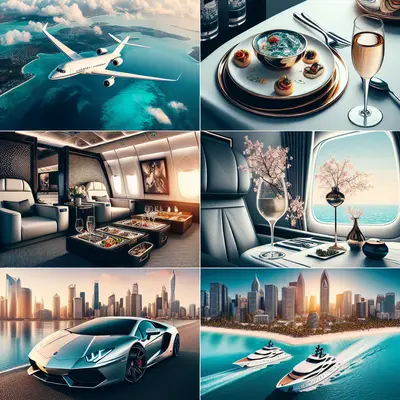
Luxury travel today is less about being seen and more about moving through the world with intention, control, and quiet precision. The most discerning travelers are no longer chasing the same overexposed suites and predictable “exclusive” experiences—they’re engineering journeys that feel tailored, unhurried, and almost impossibly seamless.
What follows is not a checklist, but a set of five insider calibrations that define how serious travelers are reshaping their time in the air and on the ground. Each insight reveals how the truly elevated trip is being assembled now: less spectacle, more orchestration; fewer upgrades, more design.
Insight 1: The Itinerary as a Private Operating System
For sophisticated travelers, an itinerary is no longer a rigid schedule; it is a dynamic operating system for their time, designed to flex without friction.
The most refined journeys start with “anchoring moments”—a dinner that truly matters, a key site at the quietest hour, a meeting that cannot move—around which everything else is built for maximum optionality. Private aviation, flexible hotel check-in, and chauffeured transfers are stitched together not as indulgences, but as tools to protect time and attention.
Elite travelers increasingly rely on discreet, high-level travel advisors and boutique agencies with deep on-the-ground relationships, rather than generic online booking paths. These advisors pre‑negotiate late check-outs, reserve “soft holds” on alternative experiences, and plan “shadow itineraries”—contingency options that can be activated when weather, mood, or priorities shift. The result is a trip that feels effortless, even when it has been meticulously engineered behind the scenes.
For Jet Ready’s audience, the benchmark is simple: if your itinerary cannot be significantly reconfigured within 24 hours without stress, it is under‑designed for the level at which you travel.
Insight 2: Luxury Is Now Measured in Friction—Not Square Footage
The design language of elevated travel is moving beyond thread counts and suite size. The new defining metric is friction: how much of it you feel, and how much has been invisibly removed for you.
Savvy travelers invest first in what they will not have to endure. This begins long before takeoff: global entry or trusted traveler programs, fast-track lanes, and biometric boarding are treated as foundational infrastructure, not nice-to-haves. In the air, it means routes chosen for punctuality patterns, aircraft type, and cabin design—not just cabin class. On the ground, it means hotels selected as much for arrival experience and service choreography as for aesthetics.
The finest properties understand this and have built what might be called “friction buffers”: dedicated airport meet-and-greet, in-room check-in, on-call butlers who solve problems before they are fully articulated, and staff empowered to override policy in favor of judgment. A perfect example: having someone quietly reroute your luggage mid-journey, without you needing to ask twice or touch a claim tag again.
At this level, friction is the new noise. The less of it you feel, the more luxurious every detail appears—even when those details are deceptively simple.
Insight 3: The Rise of Micro‑Access: Beyond “VIP” to Precision Privilege
Traditional VIP experiences—roped-off sections, generic “exclusive” areas—are increasingly viewed as blunt instruments. The most sophisticated travelers are seeking micro‑access: small, surgically specific privileges that transform a moment without transforming the mood.
Micro‑access can be as subtle as gaining entry to a museum gallery before public opening, a single table held nightly at a restaurant that never has availability, or after-hours use of a hotel pool with full staff service but no crowd. It is defined less by spectacle and more by specificity: access to an archivist rather than a tour guide, a head gardener rather than a concierge-led walk-through of the grounds.
This tier of access is rarely advertised. It is unlocked by a triad of elements: long-term relationships with high-caliber advisors, impeccable behavioral signals from the traveler (discretion, courtesy, reliability), and a willingness to value time and intimacy over mere visibility.
For Jet Ready’s clients, micro‑access is the quiet differentiator. You are no longer asking, “What’s the VIP option?” but “Who is the one person, or the one moment, that would make this experience uniquely resonant—and how do we get there without fanfare?”
Insight 4: Private Space as a Strategic Asset, Not a Status Symbol
Private jets, villas, and buyouts are no longer viewed only as status expressions; they are being treated as strategic tools in a traveler’s lifestyle architecture.
For individuals who make critical decisions daily, travel must support—not disrupt—their operating rhythm. This means choosing aircraft layouts that mirror their preferred work environment, reserving villas where family and staff circulation can be controlled like a well-choreographed household, and orchestrating entire floor or property buyouts when privacy and security intersect with high-stakes conversations.
Private space also allows for what might be called “controlled decompression.” The ability to land from a long-haul flight, walk directly into a private car, and arrive at a residence-level suite or villa where the lighting, scent, and amenities are already calibrated to the traveler’s preferences is not indulgence; it is continuity.
The most advanced setups blur lines between home and away: personal trainers fly in on rotation, chefs coordinate menus with nutritionists, and office infrastructure is duplicated in key destinations. For this tier of traveler, private space is the scaffolding that allows their life to remain coherent as their geography changes.
Insight 5: Aesthetic Consistency as the New Ultimate Comfort
Comfort in ultra-high-end travel is increasingly defined by aesthetic consistency: a design language so aligned with the traveler’s sensibilities that each new environment feels immediately legible.
Serious travelers are beginning to curate a personal “travel aesthetic profile” that goes well beyond taste in décor. It includes preferred color temperatures for lighting, material palettes (linen versus silk, stone versus wood), fragrance thresholds, acoustic preferences, and even pacing style—do they favor tranquil, minimalist spaces or richly layered, historically grounded ones?
Rather than chasing the most ostentatious suites in every city, they choose a network of hotels, residences, and aircraft configurations that share a coherent visual and tactile identity. Over time, this creates a private constellation of spaces around the world that feel like extensions of a single, finely tuned environment.
For Jet Ready travelers, the question evolves from “Is this a five-star property?” to “Does this property speak my language—visually, materially, and emotionally?” When the answer is yes, the destination feels more refined, because your mind is not negotiating with the room; it is already at ease within it.
Conclusion
The future of luxury travel is being written quietly, by travelers who care less about being impressed and more about being understood. They are designing journeys that protect their most finite resources—time, attention, energy—while weaving in encounters that feel rare, relevant, and deeply private.
At this level, luxury is no longer a category; it is a personal protocol. It is how seamlessly your itinerary adapts to you, how precisely your privileges are deployed, how intelligently your private spaces support your life, and how consistently the world feels like it has been edited to your measure.
For those ready to travel this way, the question is not where to go next—but how meticulously you want your world to be arranged when you arrive.
Sources
- U.S. Customs and Border Protection – Global Entry - Official information on trusted traveler programs that reduce airport friction
- Forbes Travel Guide - Professional evaluations of luxury hotels, resorts, and experiences with emphasis on service and design standards
- Virtuoso – Luxury Travel Network - Insight into how high-end advisors curate bespoke, access-driven itineraries
- Business Aviation – NBAA - Industry perspective on private aviation, including aircraft, operations, and business travel applications
- Condé Nast Traveler - Editorial coverage on evolving trends in high-end travel, access, and hospitality design
Key Takeaway
The most important thing to remember from this article is that this information can change how you think about Luxury Travel.