A photographer is going viral this week for making the moon look impossibly oversized using only a lens—no Photoshop, no trickery, just meticulous planning and the perfect vantage point. That story, drawn from the “Not Photoshopped: Photographer Uses Only Lens To Make The Moon Look Supersized” headline, has quietly tapped into something luxury travelers already know: the most unforgettable experiences aren’t added on in post. They’re crafted in-camera, in real time, in places the general public will never quite reach.
As social feeds fill with surreal lunar shots and conversations about the “perfect angle,” the ultra-high-end travel world is paying attention. Because for the seriously well-traveled, the next aspiration isn’t another over-water villa or another Michelin-starred tasting menu—it’s access to the night sky itself, framed by privacy, precision, and design.
Below, five exclusive insights into how the most rarefied resorts are quietly turning the moon, the stars, and the nocturnal landscape into their most coveted amenities.
1. Celestial Positioning Is the New Beachfront
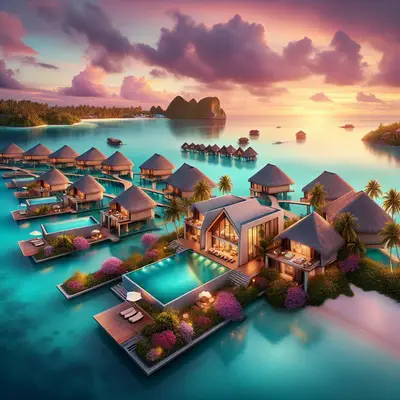
In the mainstream market, oceanfront remains the ultimate real-estate descriptor. At the top of the luxury echelon, however, developers are increasingly prioritizing celestial alignment with the same seriousness they once reserved for shoreline access. The frenzy around today’s viral “supersized moon” images echoes a quieter movement among design-led resorts in remote Chile, Namibia, the Maldives, and the Saudi and Omani deserts, where master plans are now drawn with lunar rise, Milky Way arcs, and light pollution maps in mind.
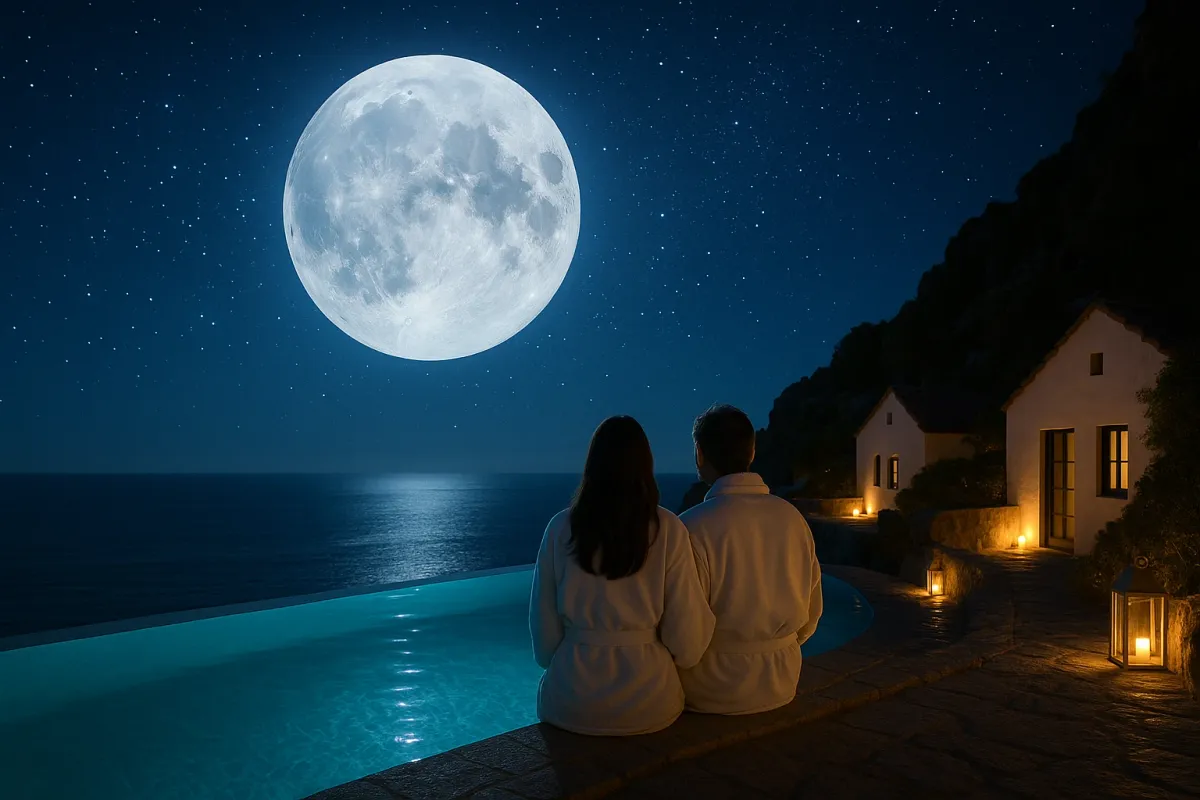
Forward-thinking operators consult astronomers and dark-sky experts long before a single stone is laid, ensuring villas, pools, and private decks are oriented for maximum night-sky theatre. The effect is subtle in the daylight—minimalist lines, generous glazing, almost monastic simplicity—but becomes undeniable after sunset, when an ordinary infinity pool feels like it spills directly into the cosmos. For guests, that means not only golden-hour perfection for social content but also a kind of nocturnal privilege: the sense that the night itself has been curated solely for them.
2. Private Observatories Are Becoming the New Wine Cellars
As the online world obsesses over how a single photographer manipulated distance and perspective to enlarge the moon, the most rarefied retreats are quietly granting guests access to professional-grade optics of their own. Where once a subterranean wine cellar signaled seriousness, today you’re just as likely to be escorted to a sleek, climate-controlled observatory perched on a dune or hillside, complete with guided sky sessions, astrophotography tutorials, and late-night Champagne service.
These observatories aren’t tourism gimmicks; they’re meticulously engineered, often in collaboration with lens manufacturers and astronomy institutes. High-end lodges in regions like Atacama, La Palma, or the Australian outback are curating dedicated “sky concierges” whose role blends sommelier, storyteller, and scientist. For discerning guests, the appeal is twofold: first, the ability to capture their own version of that now-iconic “giant moon” image with professional guidance; second, the knowledge that this level of access—unshared, unhurried, and shielded from crowds—is a luxury of both geography and investment.
3. Night Is the New Golden Hour for Wellness
The current fascination with dramatic moon imagery has also reignited interest in what happens to the body when the sun disappears and the screens go dark. The most forward-edge wellness resorts are no longer content with sunrise yoga and daytime hammams; they are exploring what might be called “lunar wellness”—programs intentionally anchored to the phases of the moon, the temperature drop after dusk, and the psychological shift that nighttime brings.
You’ll now find moonrise meditations held on secluded cliffs, circadian-friendly lighting schemes that fade into pure starlight, and thermal experiences timed to nocturnal rhythms rather than spa scheduling. Leading properties are pairing these elements with silent late-night swims under unpolluted skies, guided breathwork sessions by candlelight, and even bespoke sleep protocols coordinated with planetary alignment. For elite travelers, the draw is less about mysticism and more about exclusivity: wellness that is both chronobiologically intelligent and unattainable in a city where the night is permanently backlit by LED.
4. “Dark-Sky Design” Is the Next Discreet Status Signal
The viral moon photographs dominating today’s feeds are, at their core, a triumph of restraint—of refusing to over-edit when the raw material is already extraordinary. The upper tier of resort design is mirroring that philosophy in what insiders are calling “dark-sky design”: an architecture of deliberate omission that prioritizes what is not lit, not visible, not broadcast.
Properties pursuing this path are quietly stripping away unnecessary external lighting, using shielded fixtures, low-spectrum bulbs, and architectural silhouettes that nearly vanish at night. Private plunge pools are sunk into rock instead of crowned with neon; walkways glow just enough for safety but not enough to compete with constellations overhead. It’s a design language that reads almost invisible in photographs yet feels profound in person. Among connoisseurs, being able to say, “You can barely see the resort at night from the water” is becoming as much of a flex as listing the architect’s name or the number of Michelin stars on property.
5. The Rarest Perk: Nighttime That Cannot Be Replicated on a Screen
What has made today’s moon story so shareable is the illusion that, with the right lens, anyone could recreate it. In reality, most people are limited by urban glare, crowded viewpoints, and lack of technical guidance. Ultra-luxury resorts are quietly building their value proposition on the opposite promise: experiences that cannot be reproduced through filters, AI, or image stacking—because they arise from a specific confluence of latitude, topography, climate, and radical seclusion.
Think of a private dinner set entirely in candlelit shadow on a dune ridge, with a telescope aligned to the very crater you just saw trending on your feed. Or a midnight boat drift in a bioluminescent bay where the stars above mirror the light beneath the water, your phone deliberately locked away in a leather case at your request. These moments are difficult to photograph well and almost impossible to fake credibly—and that is precisely the point. For a clientele accustomed to everything being replicable, owning a memory that resists duplication has become the ultimate luxury.
Conclusion
As today’s supersized moon photos race across social media, the most discerning travelers are reading them as an invitation, not just a spectacle. The viral images underscore a simple truth: with the right vantage point, the ordinary becomes extraordinary—no filters required. The world’s most exclusive resorts are embracing that philosophy at scale, turning geography, shadow, and sky into their most precious amenities.
The next generation of elite escapes will not be defined merely by how close you are to the water or how high-thread-count your linens are, but by how profoundly your surroundings change when the lights go out. In an era when almost everything can be enhanced after the fact, the most coveted luxury is increasingly the one that feels, unmistakably, like it was composed in-camera—by the moon itself.
Key Takeaway
The most important thing to remember from this article is that this information can change how you think about Exclusive Resorts.