There is a particular kind of traveler who has already seen every infinity pool, every over‑water villa, every glacial‑white beach in a dozen time zones. For them, luxury is no longer about adding more opulence; it is about distilling experience down to what feels elemental, rare, and almost impossible to repeat. That is precisely why the Northern Lights—currently trending again after a fresh wave of viral aurora photography features and first‑person accounts—have moved from bucket‑list fantasy to the new frontier of ultra‑luxury travel.
With recent articles spotlighting the best places and precise timings to witness the aurora borealis, demand is rising sharply for private, design‑driven escapes at the edge of the Arctic Circle. But while social media is awash in colored skies and glass igloos, the truly elevated aurora journey operates in a different universe: private astronomers instead of “aurora apps,” chefs trained in both Nordic foraging and Michelin‑grade tasting menus, and architecture that frames the sky as though it were a commissioned artwork. Below, five discreet insights for those looking to experience the Northern Lights at the highest possible level—before the rest of the world catches up.
Designing A “Sky Residence” Instead Of Booking A Room
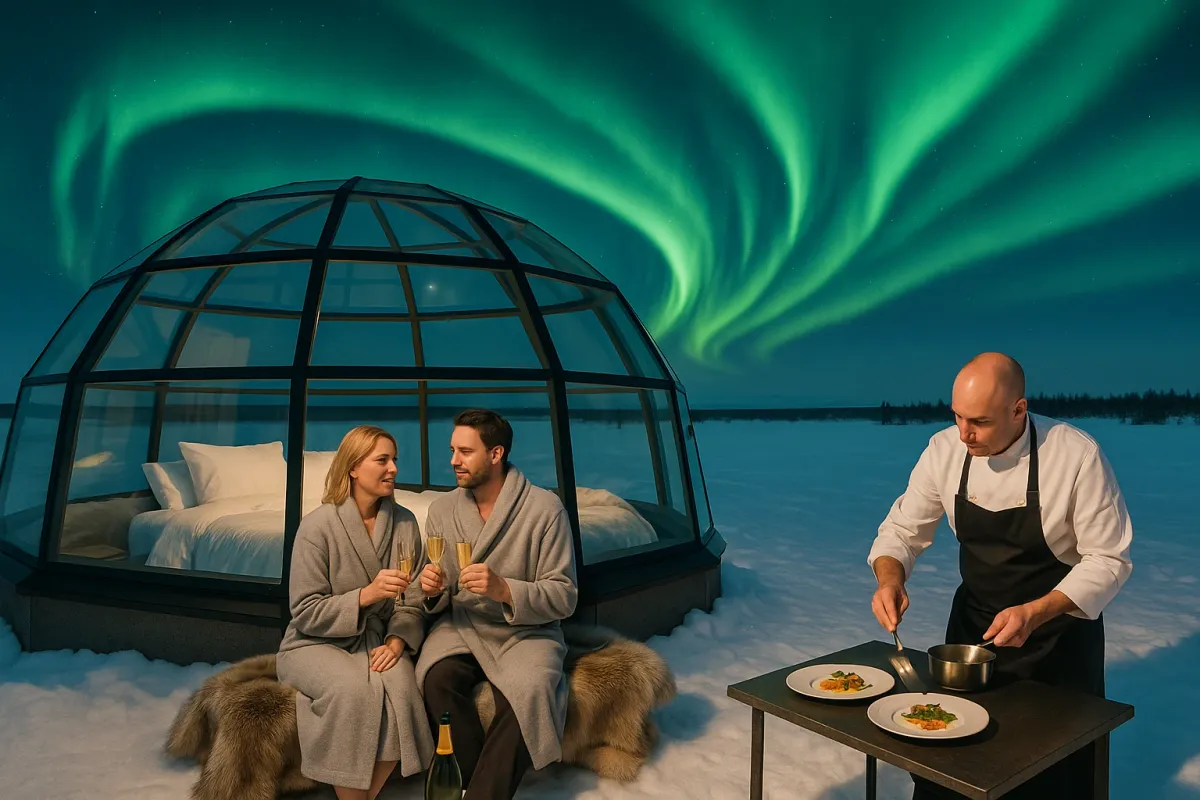
As aurora travel enters the global conversation again—propelled by first‑hand guides detailing where and when to go—top‑tier properties in Norway, Finland, Iceland, and Swedish Lapland are quietly escalating what a Northern Lights stay can be. The sharpest luxury travelers are no longer searching for “glass igloos” or “aurora cabins”; they are commissioning what can only be called sky residences. These aren’t gimmicky domes on crowded hillsides, but architect‑designed spaces—often cantilevered over frozen lakes or tucked into ancient pine forests—that treat the night sky as prime real estate.
Think heated, floor‑to‑ceiling electrochromic glass that adjusts to moonlight; acoustically insulated walls so that the only sound is the snow settling outside; underfloor heating calibrated to bare feet moving from wool rug to stone, even at 2 a.m. Some Scandinavian design studios now collaborate directly with private clients, planning one‑off structures that can be disassembled and relocated within the same wilderness, ensuring your view of the aurora is never repeated in quite the same way. The new definition of a “suite upgrade” in this space is no longer about square footage—it is about the geometry of the sky above your bed.
Timing Trips Around Solar Weather, Not School Holidays
Much of the recent coverage around the Northern Lights has focused on the best seasons and locations from an enthusiast’s perspective. The luxury traveler, however, now plans aurora journeys with the same precision that others reserve for Monaco race weekends or couture fittings in Paris. The most informed guests are starting to time their escapes not around school calendars, but around solar cycles, space weather forecasts, and the subtle interplay between geomagnetic storms and high‑latitude weather systems.
Private travel planners are quietly partnering with astrophysicists and observatory teams who monitor the sun’s activity in real time. Instead of generic “September–March is a good window” advice, itineraries are created for very specific 5‑ to 7‑night corridors when the probability of intense auroral displays and clear skies overlaps. For ultra‑high‑net‑worth travelers, flexible departure windows on private jets or first‑class cabins become part of the experience: hold dates lightly, then lock them only when the solar wind is right. In the most rarefied circles, seeing the aurora is no longer luck—it's an orchestrated alignment of astronomy, meteorology, and your calendar.
Transforming Aurora Watching Into A Nightlong Ritual
Recent first‑person accounts of Northern Lights trips tend to read like weather reports: “The lights appeared; we rushed outside; they faded.” At the elevated end of the market, that hurried, transactional experience is being replaced by a curated nocturnal ritual where the sky is only one part of the evening. The best lodges and private camps now choreograph the night in slow, thoughtful acts: a twilight sauna session with birch‑infused steam, a snow‑forest walk by lantern light, a supper club‑style tasting menu built entirely around polar ingredients, then a return to fireside lounges with low‑lit libraries and vintage aquavit.
Aurora alerts—once shrill phone notifications—are now woven gently into this rhythm. In some properties, staff slip in silently to adjust lighting when activity begins, drawing curtains back without breaking the mood. Others issue you with a discreet, vibrating wristband that only activates if the display reaches an agreed intensity, ensuring that you’re not pulled from a perfectly poured wine for a faint green smudge. The entire night becomes a series of sensorial calibrations: thermal layers tailored by a private outfitter, heated outdoor loungers facing magnetic north, cashmere throws warmed in hidden cupboards. In this world, you don’t “go out to see the lights”; the entire evening is constructed so the lights join you.
Elevating Local Culture Beyond Token Storytelling
As mainstream articles drive renewed attention to aurora destinations, some regions are responding by doubling down on mass‑market experiences: simple bus tours, crowded viewing decks, identical folklore presentations. The true luxury response moves in the opposite direction—toward depth and discretion. Ultra‑high‑end guests increasingly expect the Northern Lights to be a gateway into Sámi, Inuit, or Nordic culture, not a backdrop for a quick selfie.
Forward‑thinking properties are now co‑creating programming directly with Indigenous communities and local artisans: private joik (traditional Sámi song) performances for just two guests; one‑on‑one sessions with reindeer herders discussing land stewardship under a sky they’ve used as a compass for generations; bespoke commissions of duodji (traditional Sámi handicraft) where the color palette is matched to an aurora you actually witnessed the night before. In the most thoughtfully designed itineraries, nothing feels like a staged show for tourists. Instead, the aurora becomes a shared reference point: something both visitor and host read together in the sky, each in their own language of meaning.
Treating Sustainability As A Design Principle, Not A Slogan
With global coverage spotlighting Northern Lights hotspots and social feeds overflowing with time‑lapse videos, there is a real risk of over‑tourism in fragile Arctic landscapes. Luxury travelers, increasingly alert to this, are beginning to treat sustainability not as an optional note in the brochure, but as a central design filter for where they stay and how they move. The most advanced properties now view low‑impact architecture, energy systems, and guest numbers as markers of status, not sacrifice.
Look for lodges powered by a blend of geothermal and hydropower, with on‑site carbon accounting you can actually audit. Helicopter transfers are being replaced, where possible, by sleek electric snowmobiles or even silent dog sleds guided by expert mushers—a shift that feels less like compromise and more like privilege. Menus lean deeply into hyper‑local sourcing: line‑caught fish from nearby fjords, mushrooms foraged at first frost, cloudberries preserved in the short autumn. At the highest level, some operators are offering structured “leave more than you take” options: funding dark‑sky conservation zones, supporting Sámi education programs, or contributing to research into how climate change is reshaping the very auroras guests are there to see. In this realm, true luxury is not just witnessing a luminous sky; it is ensuring that such skies remain dark enough to glow.
Conclusion
As the latest wave of features and personal accounts propels the Northern Lights back onto global wish lists, the conversation at the top of the market is shifting quietly, but decisively. For those who travel in private cabins and collect experiences instead of souvenirs, an aurora journey is no longer a scramble into the cold with a camera. It is the composition of a rare, almost ceremonial interlude: a sky residence designed around the horizon, nights paced by star charts instead of reservation times, and a feeling that you are a temporary guest in both a landscape and a culture that pre‑date modern tourism by centuries.
In the coming seasons—especially as solar activity continues to rise—high‑latitude regions will only grow more visible on social media. The difference for the discerning traveler will be in how invisibly everything else is managed: the science quietly underpinning your perfect timing, the design decisions you feel but never notice, the communities you engage with respectfully rather than consume. When done well, a Northern Lights journey at this level doesn’t just show you a spectacular sky; it re‑sets your internal definition of what “once in a lifetime” is allowed to mean.
Key Takeaway
The most important thing to remember from this article is that this information can change how you think about Luxury Travel.