Fine dining, at its most compelling, is no longer a performance staged for a room; it is a conversation held in confidence. For the luxury traveler, the true pleasure isn’t simply the Michelin constellation or the trophy reservation. It is the sense that a room, a brigade, and a cellar have been quietly aligned around your preferences—often before you’ve voiced them. In the world Jet Ready inhabits, fine dining becomes less about spectacle and more about precision: of timing, of sourcing, of service, of memory.
Below, five exclusive insights define how discerning travelers can read, and influence, this new language of the table.
1. The Art of the Unlisted: Menus That Only Appear for You
The most sought-after menus are increasingly the ones you never see printed.
At top-tier restaurants, especially those attached to flagship properties or private residences, chefs maintain “shadow menus”—variants and sequences designed for a handful of in-the-know guests. These are not simply off-menu substitutions; they are parallel narratives, built on ingredients the restaurant would not dare list publicly due to scarcity, price, or limited availability.
For the well-traveled guest, access begins before arrival. Share dietary considerations, texture preferences, and culinary curiosities discreetly but precisely, often through a guest relations manager or a dedicated concierge. The best properties maintain detailed guest profiles across visits and destinations, allowing a chef in Tokyo to understand your aversion to heavy cream from a note entered in Paris.
The experience, when it works, feels startlingly intimate: courses that echo meals you loved five years ago, seasonal ingredients that rarely leave private collections (single-estate caviar, small-boat line-caught fish, antique citrus, micro-lot olive oils), and presentations that deliberately avoid the over-photographed “signature dish.” To the room, you are simply another table. To the kitchen, you are the reason that evening’s unlisted menu exists.
2. Precision Pairing: Beyond the Wine List and Into the Cellar
For luxury travelers, the wine list is no longer the decisive marker of quality; the cellar philosophy is.
The most sophisticated properties curate not only verticals of iconic producers, but also micro-lots, library releases, and producer-direct allocations rarely seen in public dining rooms. The real luxury is not the label itself—it is access to a sommelier who understands how you like to drink, not just what you like to drink.
Increasingly, serious programs are moving toward:
- Cellar-only pours: Wines not printed on the list, offered by the glass from rare bottles opened for a select few tables that evening.
- Cross-venue continuity: Hotel or group cellars shared across multiple restaurants, allowing a beloved Burgundy or aged Champagne to follow you from the bar to the dining room to an in-suite course.
- Low-intervention and heritage pairings: A considered mix of benchmark classics with rigorously vetted natural, biodynamic, or historic producers, chosen for texture and energy as much as prestige.
For the traveler, the key is subtle conversation in advance: noting vintages you remember fondly, regions you’d like to explore, and your preferred structure (you may favor fragrance over power, salinity over sweetness). Exceptional sommeliers will quietly redirect the evening, pulling bottles you never see cross another table, or decanting a mature wine in a discreet corner to avoid making your order a spectacle.
3. Time as the Ultimate Luxury: Pacing, Privacy, and the Architecture of a Meal
In the premium sphere, time is curated as attentively as ingredients.
Luxury travelers increasingly value courses that breathe rather than rush, and service teams that read the unspoken tempo of the table. In this arena, the experience is engineered not simply through staff training, but through spatial design: semi-private alcoves, buffered soundscapes, and lighting that softens the presence of neighboring tables.
The finest dining rooms orchestrate:
- Invisible corridors that allow staff to appear and disappear without interrupting conversation.
- Flexible pacing where the kitchen sequences your meal around your evening—moving faster when you arrive from a long flight, slowing for extended business negotiations or intimate celebrations.
- Course clustering—for instance, two small plates arriving together to allow you to alternate bites and set your own rhythm.
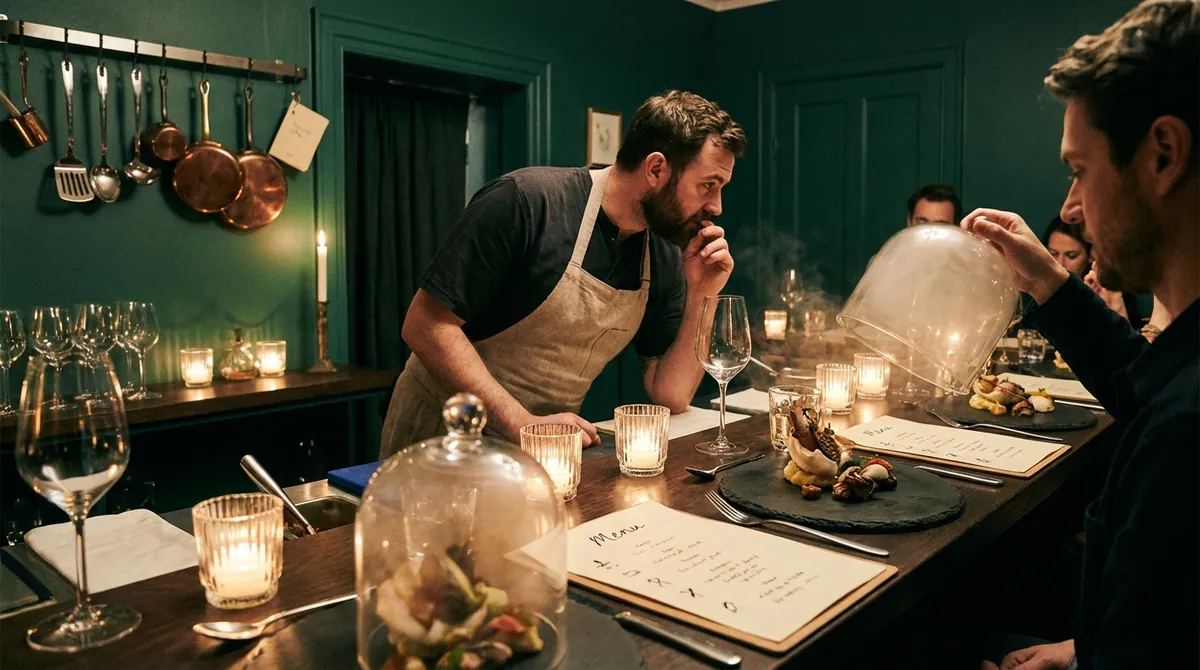
In some properties, the most treasured experiences occur just adjacent to the dining room: a course taken in the kitchen at a private counter, a final dessert and digestif moved to an art-filled salon, a cheese course enjoyed on a terrace that was ostensibly “closed for the night.” To the refined traveler, this choreography of space and time is the clearest signal that the restaurant understands luxury as a tailored cadence, not a fixed script.
4. Provenance as Discretion: Quiet Sourcing for the Well-Informed
Public menus now routinely list farms and regions. For the serious traveler, the true story sits one layer deeper.
Elite properties are building relationships not just with well-known producers, but with hyper-specific sources: a single hillside for their tea, a particular reef for their shellfish, a lone orchard for a specific varietal of stone fruit. The quiet luxury is not the name on the menu, but the guarantee of integrity that sits behind it.
When you travel frequently, these patterns become legible:
- The same single-origin chocolate served, in different expressions, across sister properties.
- A particular type of heritage grain appearing in pasta in Rome, bread in London, and pastry in New York—each iteration a regional interpretation of a shared supply chain.
- Private-label bottlings of olive oil, Champagne, or sake, produced in tiny quantities exclusively for a given brand.
The most refined restaurants will not declare every detail publicly. But a brief, informed question—about the mill behind a flour, the fishery behind a crudo, the fermentation behind a soy or miso—often unlocks a richer layer of the story. It signals to the team that you are not merely consuming status; you are participating in a global network of artisans whose work you recognize and respect. In return, you may find rare ingredients or experimental preparations quietly routed to your table.
5. Memory as Craft: How the Best Restaurants Remember You
In the emerging era of premium travel, a restaurant’s most valuable asset is not its plates or glassware; it is its memory.
Top-tier operators maintain extraordinarily detailed guest intelligence, shared—securely and discreetly—across properties and even continents. This intelligence is not about surveillance; it is about hospitality continuity. Your preference for a particular mineral-driven water, your habit of declining bread, your smile at an unexpected small plate—these become notes in a living archive.
For the luxury traveler, this plays out in subtle but unmistakable ways:
- The second time you dine, your favorite cocktail appears, gently reinterpreted, without you asking.
- A server references a dish you loved on another continent and presents tonight’s course as its seasonal cousin.
- A pastry chef who once designed a custom dessert for your anniversary sends a miniature echo of it, years later, when you arrive alone on a business trip.
This is where fine dining becomes truly premium: when the room feels choreographed around who you are, not what you ordered. The smartest travelers cultivate this continuity by building long-term relationships with a small constellation of brands and properties, signaling appreciation for this memory work and reciprocating with loyalty. Over time, dining ceases to be a series of reservations and becomes an ongoing dialogue across cities, seasons, and itineraries.
Conclusion
For the modern luxury traveler, fine dining is no longer defined purely by stars, accolades, or reservations that are difficult to obtain. It is defined by the invisible systems that make you feel unexpectedly known: the unlisted menu that fits your mood flawlessly, the cellar that anticipates the way you like to drink, the pacing that follows your internal clock, the provenance that rewards your curiosity, and the institutional memory that stretches across borders.
In this new landscape, the most refined move is not to chase every new opening, but to deepen your relationship with a handful of dining rooms that reward attention with ever-greater subtlety. The result is an experience that feels less like a night out and more like an ongoing, highly personal chapter in the story of how—and where—you choose to live well.
Sources
- [Michelin Guide – Official Site](https://guide.michelin.com/) - Provides insight into global fine-dining standards, chef philosophies, and evolving trends in luxury restaurants
- [The World’s 50 Best Restaurants](https://www.theworlds50best.com/) - Highlights leading restaurants worldwide, with interviews and features on sourcing, service, and experience design
- [Wine Spectator – Restaurant Awards](https://www.winespectator.com/restaurants) - Details notable wine programs and cellar philosophies that shape premium pairing experiences
- [Cornell University School of Hotel Administration](https://sha.cornell.edu/faculty-research/centers-institutes/chr/research/) - Offers research on hospitality operations, guest experience, and service innovation relevant to high-end dining
- [World Resources Institute – Sustainable Food Features](https://www.wri.org/topics/food) - Provides context on responsible sourcing, provenance, and sustainability practices increasingly embedded in luxury dining
Key Takeaway
The most important thing to remember from this article is that this information can change how you think about Fine Dining.