In the rarefied tier of travel, “where” you stay matters less than “how” it feels. The most discerning guests are not chasing square footage or brand names; they are curating states of mind. Exclusive resorts—those properties that rarely advertise and almost never discount—operate in a different frequency. The experience is orchestrated with the precision of a private recital: nothing loud, nothing hurried, nothing accidental. For travelers who prize subtlety over spectacle, understanding the quiet codes of these retreats is the key to unlocking their most exceptional layers.
Below, five exclusive insights reveal how today’s luxury travelers read, shape, and elevate their time inside the world’s most discreet sanctuaries.
1. The New Signature Amenity: Curated Stillness
Among truly elevated resorts, stillness is no longer an absence of noise; it is a designed, deliberate feature. Architectural lines, materials, and spatial planning are chosen less for Instagram impact and more for what they do to the nervous system.
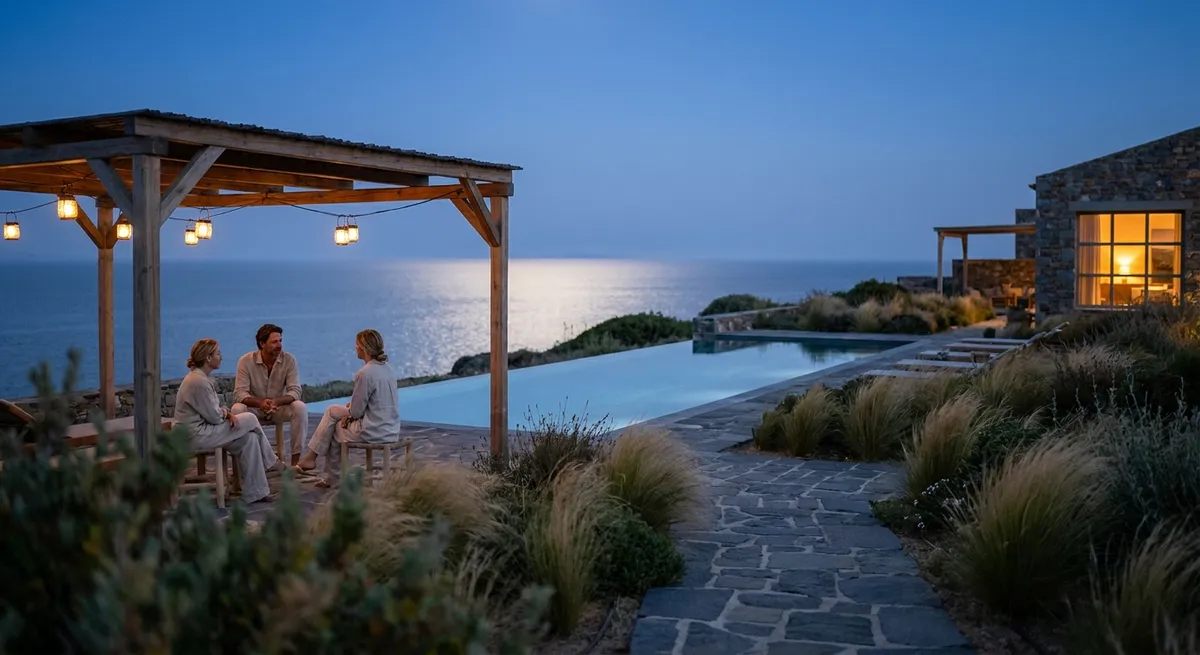
Consider how the most sophisticated properties position themselves: away from flight paths, insulated from road traffic, with terraces that face prevailing winds rather than busy marinas. Pathways are softened with stone and sand to mute footsteps. Pools are designed with vanishing edges not only for the view, but to diffuse the sound of water so it becomes a low, continuous hush rather than a splash.
Indoors, the quiet is tuned as precisely as a concert hall. Ventilation systems are nearly silent; minibars are concealed behind millwork; doors close with a subdued, satisfying weight, not a hotel-corridor slam. The lighting plan minimizes glare, allowing your eyes—and mind—to relax.
For luxury travelers, the insight is simple: stillness is now a premium amenity. When choosing a resort, study not just the view, but the spatial choreography. Ask about soundproofing, room orientation, and the layout of public areas. The most sophisticated properties can describe, in detail, how they designed for silence.
2. Off-Menu Everything: The Art of Unpublished Privileges
In the most rarefied resorts, the most meaningful experiences rarely appear on the website—or even the room compendium. They exist in the realm of what might be called unpublished privileges: experiences, access, and gestures that are intentionally kept off-menu to protect their intimacy and spontaneity.
These may look like a private tasting in a part of the property that is never photographed, or a sunrise access slot to a UNESCO-listed site normally crowded by mid-morning. At some coastal retreats, dive masters or marine biologists quietly escort favored guests to reef locations absent from public maps, carefully balancing access with conservation. In wine regions, a manager might unobtrusively arrange a tasting in a family-owned vineyard that does not host the general public.
The key is that these gestures are never marketed; they are surfaced only when a guest’s preferences, timing, and temperament suggest they will be appreciated—and not abused. Frequent guests learn that questions framed with nuance (“Is there anywhere on property you especially love at dawn that isn’t in the guest guide?”) often unlock layers of experience official channels never mention.
Understanding this off-menu culture changes how luxury travelers approach a stay. Rather than demanding specific perks, they provide rich context—why they’re traveling, what they collect, how they like to feel. The more precise the portrait, the more confidently a truly capable resort can reach into its private reserve of possibilities.
3. The Private Network Effect: When a Resort Becomes a Global Key
For those who travel at the highest level, a single exceptional resort is rarely an isolated destination; it is a durable node in a curated global network. The best properties act as discrete conduits to other worlds—bespoke yachts, private museums, remote lodges, invitation-only events—through quietly personal introductions rather than membership cards.
Imagine checking out of a Seychelles hideaway with no more than a conversational mention of your upcoming time in Paris. Two weeks later, the concierge there has arranged a private viewing at a gallery whose owner “happens to be an old friend of the general manager you met on the island.” Or a favored safari camp in Botswana has already shared your photographic preferences with an Arctic lodge in Svalbard, ensuring the helicopter pilot on a polar expedition understands your tolerance for weather and risk.
This is the private network effect: a lattice of relationships, personal knowledge, and trust connecting properties that recognize and subtly advocate for the same guests. It operates quietly, often without explicit branding. The more respectfully and consistently a traveler engages with one node—communicating clearly, honoring time, tipping thoughtfully—the more fluidly the network opens across continents.
Astute travelers treat every stay as an opportunity to invest in this long game. They remember names, send notes of thanks, and share nuanced feedback. Over time, a selected constellation of resorts begins to feel less like a string of bookings and more like a personally tailored global operating system.
4. Refined Sustainability: Beyond the Visible Green Gesture
At the top tier of exclusive resorts, sustainability has moved far past bamboo straws and visible virtue-signaling. The most sophisticated properties understand that their guests are increasingly data-literate and expect evidence that “eco” is more than an aesthetic. Environmental and social responsibility is integrated quietly into operations, not staged as a photo opportunity.
Water systems, for instance, are often where the real work happens: on-site desalination or advanced filtration, closed-loop greywater reuse for gardens, and landscaping with native flora that demands little irrigation. In some island or coastal properties, marine conservation programs are run in partnership with universities or NGOs, with guest access deliberately restrained to maintain scientific integrity as much as guest experience.
Energy is similarly subtle. Photovoltaic arrays may sit out of sight, while rooms are engineered with deep overhangs, cross-ventilation, and high-performance glazing to reduce the need for air conditioning. Food programs prioritize what can be sourced within a tight radius, not only for flavor but to depress the property’s logistical footprint. Staff training goes beyond service scripts to include genuine environmental literacy, enabling real conversations about local ecosystems and culture.
For luxury travelers, the differentiator is transparency over theater. Discerning guests inquire about third-party certifications, local hiring practices, and long-term community relationships. The properties truly operating at a higher standard can speak in specifics: kilowatt hours produced on-site, percentage of staff from nearby communities, years of partnership with local schools or conservation groups.
The new luxury is knowing that your stillness has not been subsidized by someone else’s depletion.
5. Scriptless Service: When Anticipation Replaces Performance
Among exclusive resorts, the true mark of refinement is not the number of staff per room or the flourishes of a welcome ritual; it is the almost unsettling feeling that everything you need has been considered before it even becomes a thought. This is scriptless service: hospitality that feels more like a long-standing friendship than a stage-managed production.
The mechanics are intricate but invisibly executed. Pre-arrival questionnaires are distilled into discreet notes, not checklists. A preference for walking at sunrise rather than sunset might translate into a trail map slipped under your door only on clear mornings. A passing remark at dinner about a childhood dessert appears the next evening, not as a showy surprise but as if the kitchen simply happened to have it.
Staff are trained not merely in procedure, but in observation—reading body language for fatigue, interest, or overstimulation. If a guest lingers over a specific artwork, a catalog or gallery recommendation may quietly arrive later. If a traveling couple appears to be working through a tense conversation, a favored corner table might “suddenly” free up at a distance from the main dining area.
The sophistication here lies in restraint. Unlike performative luxury, which insists on being noticed, scriptless service is designed to be felt more than seen. The well-traveled guest responds in kind, signaling appreciation without theatrics and offering just enough information—verbal and non-verbal—for the property to refine its calibration. Over multiple stays, the relationship matures into a quiet, almost telepathic understanding.
Conclusion
The world of exclusive resorts is not defined by logo counts or architectural spectacle, but by nuance: the curated stillness, off-menu privileges, interwoven networks, rigorously understated sustainability, and scriptless service that together create a rare atmosphere of ease. For luxury travelers, the real privilege is no longer access alone; it is being recognized, remembered, and gently reinterpreted from one journey to the next.
Those who learn to read these subtle signatures—and to respond with equal discretion—discover that the finest retreats do more than host a stay. They become trusted custodians of how you move through the world: quietly, precisely, and entirely on your own terms.
Sources
- UN World Tourism Organization – Tourism in the 2030 Agenda - Overview of sustainable tourism principles shaping high-end resort strategies
- World Travel & Tourism Council – Environmental Management for Hotels - Industry guidance on advanced sustainability practices in luxury accommodations
- Condé Nast Traveler – Gold List - Curated selection of top-tier resorts and hotels exemplifying discreet, high-level service
- Forbes Travel Guide – What Makes a Five-Star Hotel - Criteria and philosophy behind service, privacy, and experience at the most exclusive properties
- Harvard Business Review – The Value of Keeping the Right Customers - Explores relationship-based service models that underpin loyalty strategies at elite resorts
Key Takeaway
The most important thing to remember from this article is that this information can change how you think about Exclusive Resorts.